Friday, 18 February 2011

June, 2010; Day 6 - The Trans-Siberia, 到着: Gorkiy to Moscow

Overnight, K3 did a few things while I was asleep: passed through Balezino and Kirov stations, crossed the Vyatka River, skipped one entire timezone (GMT+5), and hurled right into Moscow time.

This was Day 6, and the final day of the journey. We are now in GMT+4 timezone, while is also Moscow time.
Since crossing into Russia, we had crossed eight rivers. The K3 had one final one to crossed, and one of the most venerable in Russia: the Volga, which is about 1km wide at this point.


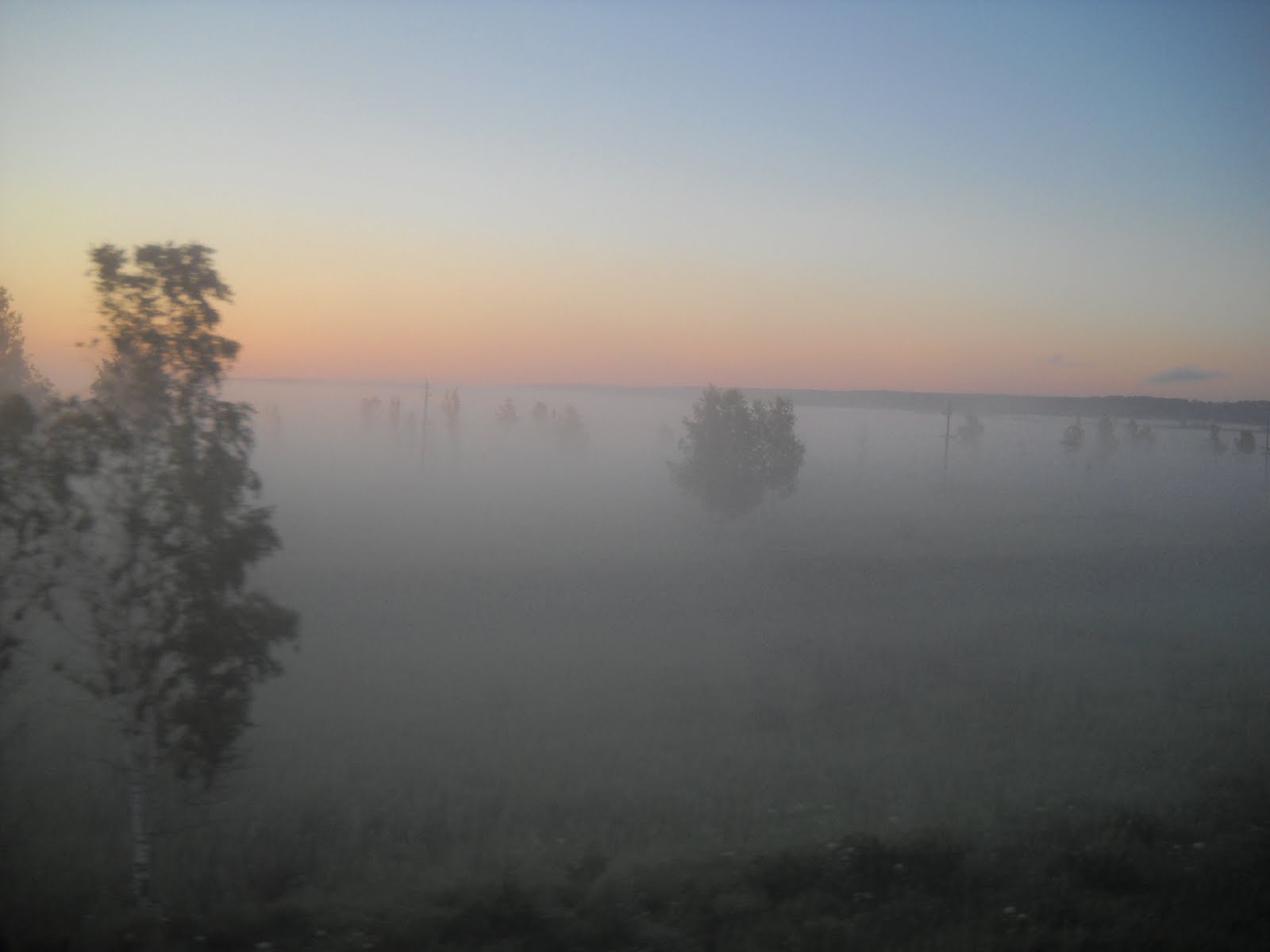
Before the next station comes into sight, sign of the city.


At about 7 in the morning, the train arrived in Gorkiy, once Nizhny Novgorod, the fourth largest city after Moscow St. Petersburg and Novosibirsk.
We are now less than 500k from Moscow, Yippeee!!!
After 5 full days on the road, I have adjust my biological clock from Singapore's GMT+8 to Moscow time. At 8am local time, I got down to breakfast of egg muffins, the very last few item of my ration of mostly oranges, bread and instant noodles.
Almost time to say farewell to the water boiler, indispensable for making coffee and instant noodle.
Gorkiy is one of the Golden Ring cities. Golden Ring is one term I used to associate with Russia, because since tour agents started offering package tour into Russia, it had more or less been "Moscow and the Golden Ring!!!" on their adverts.
Between Gorkiy and the next station are the Golden Ring towns. There seems to be quite a few large churches along the way.
Four hours before Moscow, we arrived at Vladmir. At the platform, some Russian guy tapped on my shoulder and warned me about taking pictures of the station. The station does look a bit like a fortress.
After leaving Vladimir, the Chinese train crew started with their cleaning duty. Sweeping the corridor, wiping down the railings, and giving the toilet a washup. Then some Russian officials made their appearance. They were here to make an inspection before the train arrived at Moscow.
It was also time for me to packed up. And to go brush my teeth. And to slide the door of my room closed while I wipe myself with packs of wet tissue. And also to check out how to get to my hostel on the metro. All this in the 1 hour as the train approaches Moscow.
At half past 2pm, the K3 arrived at her destination Moscow. Or the Yaroslavsky station, to be precise, as there were three train stations right next to each other.
Now, to find a money changer...
________

June, 2010; Day 5 - The Trans-Siberia, Inter-Continental Ballistic: Ishim to Perm II


In the middle of the night, the train passed through Omsk, Siberia second largest city, as I stayed in bed.
At about 3am, local time, the train approaches Ishim, a region of lakes and swamps. These may have lower the temperature down a few notches, for the first time on this trip, I enjoyed curled up under the China railway-supplied blanket.
A peep out of the window and I was reminded of Sean Penn in Mystic River.

Very soon, the train pulled up in Ishim station. At that hour, it seems only the soldiers are out. I went back to warm bed.
Four hours later, comes sign of another approaching large station: grannies, or babushkas, on platform of smaller stations.
We are head for Tumen Station, of Siberia oldest town.
At the platform was a signboard warning against playing football on the track. A reminder that away from this narrow corridor of Trans-Siberia railway, the rest of the world is in the middle of World Cup fever. Although the crew on board did follow the games on their shortwave radio.
The marker of "2139" at the Tumen station. According to my Trans-Siberia, Tumen should be at the "2144km" mark. In any case, we were edging towards the end of Siberia. At the 2102km mark, the west Siberia plain will end and the Urals would soon begin.
Flowers in the Urals.
Slightly before noon, the train arrived in Sverdlovsk, largest city in the Urals.
It actually has English sign at the entrance to the underpass that says "Exit to Sverdlovsk Str".
Another curious thing about Sverdlovsk is that it was once known as Yekaterinburg. The name change may be the result of a piece bloody history. In July 1918, the last tsar, Nicholas II, his wife, and their children, including the Grand Duchess Anastasia were murdered by the Bolsheviks at the Ipatiev House in this city. The House had since been torn down. In its place is the appropriately-named Church of the Spilt Blood. I imagine these may have attracted non-Russian visitors to the city, thus the English sign.


On the platform, another sign warning against playing football.
Since leaving Tumen, I have been looking out for these kilometer marker by the track, counting down as the number on them goes down in the direction of Moscow.
After Sverdlovsk, I got my camera ready as I counted down the marker. As the train climbed up the highest point of the Urals, what looks like an over-sized tombstone appeared at 1777km. This is the Europe-Asia Border Oberlisk. Officially, we have crossed into Europe from the Asia continent.
What awaits us in Europe was another river th cross, the Sylva.
And beyond that, the reward of some of the best scenery in Russia from the train window. The Kungur forest steppe is birch, oak and pine; duchas and what looked like resort houses...
...and holidaymakers row-row-rowing their boats gently down the stream, merrily merrily merrily merrily, for life is but a dream.
I made a note that, if possible, I would like to get off the train and stay a couple of nights the next time.
At about 5pm, signs of another city...
as the train arrived in Perm II. Yes, the train used to stop at Perm (the first), which is supposed to be closer to the city centre.
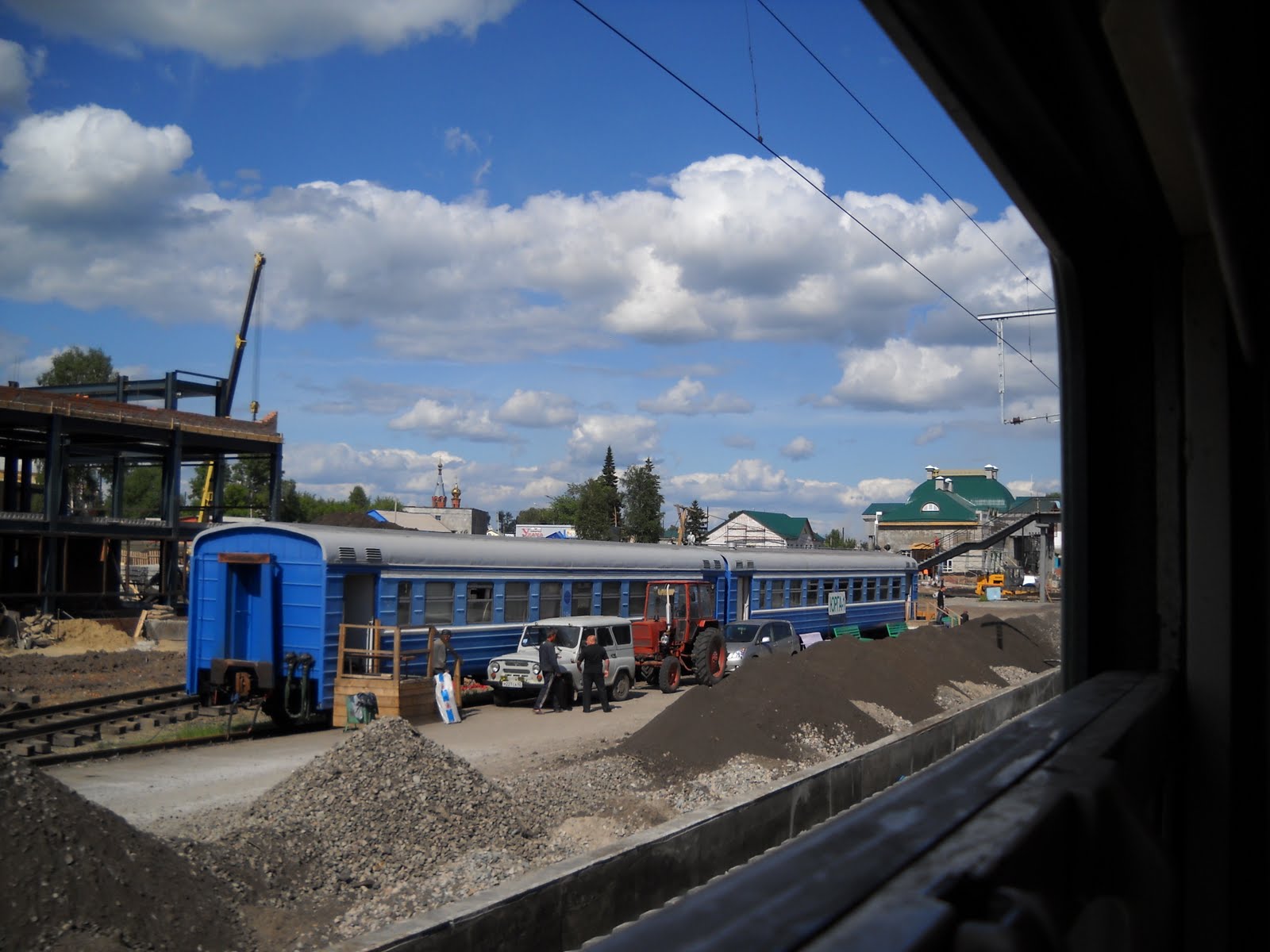
As the train left Perm, it crossed the Kama River, which flows from the Urals to the Volga.
As for the River Volga, that will have to wait as she comes on in Day 6.

Thursday, 17 February 2011

June, 2010: Day 4 - The Trans-Siberia: We're half way there: Krasnoyarsk to Barabinsk


Over the night, the train crossed the halfway point between Moscow and Vladivostok, passed Ilanskaya station and into GMT+8 timezone.

At daybreak, the train crossed the Yenisey River as it approaches Krasnoyarsk station.
The river would eventually empties into the Arctic Ocean.
While it has been a full day since crossing the border, Siberia so far had not felt like Russia to me. It was either the stations was so deserted or, as in Ulan Ude, the population was more Asian than European. Krasnoyarsk straddles eastern and western Siberia, after crossing it, we are into western Siberia, and things start to look more Russian/European.
It is also here that I got my first Russian welcome. A russian labourer unloading luggages gave me the middle finger while I looked on from the train window. He looked like he had a hangover. He also looked like his parents are siblings.

It's also the first time I got to take a good look at the stuff selling from the platform kiosk. Unfortunately, without ruble on me, I could only window-shop, and try to read the cryllic on the packaging.
Notice the timeslip at the platform, the railroad signboard showing 4:06 (Moscow time), and the red LED sign on the building showing 8:05 (local). Any girl can leap from the platform and call herself the "girl who jump through time".
The scene outside got more European to me. Pine trees, log houses and small plots of farm and garden.
Around noon, the train would had passed the 3932km marker, halfway between Moscow and Beijing.
At lunch time (going by my biological clock, of course), I went into the Russian restaurant car. With pen-and-paper, I worked out the exchange rate for US$ and ruble with the waiter, and settle for what turned out to be waffles topped with smoked salmon. This costed me US$10 with a 20 ruble change. At last, some ruble in my pocket.


After lunch, the K3 crossed the Kiya River (I think),
...and arrived at Malinsk, named after Maria Alexandrova, the German wife of Tsar Alexander II.
The Malinsk station is a solid red-brick building. By now, you would expect each new station the train arrived at to have her own distinct character. Even the smaller ones that the train just whizzed pass have their own charm.

The weather in west Siberia is definitely sunnier than east Siberia, and the landscape flatter, the view less obstructed by the (taiga) trees in the east. The shades of color 'blue' seems to have the 'habit' of getting their names from the places they are associated with. Bondi Blue from the Australian beach, and China Blue from Chinese porcelein. As I survey the summer sky, I start to imagine that the blue of the Russian flag must be the same as this Russian sky.
"I've been working on the railroad, la la la la la la......." (btw, Day 4 is a Friday.)
About 6 hours from Malinsk, tiny stations started to fly by the train. These usually just come with a gate, chain-linked fence along the platform, and simple no-frill benches on the platform. These are stations that serve the suburbs of large cities, along which local lines ply. Once in a while, you will see grannies waiting for a train to take them home from their supermarketing.
After these suburb stations, sign of the city comes into view.

And not just any city. Novosibirsk, New Siberia, the capital city of western siberia, with the largest station in Siberia.

Novosibirsk station takes on a mint green color scheme, which make me want to get a chocolate bar at the kiosk. Too bad I only had 20 ruble with me.
Leaving Novosibirsk station, we crossed the Ob River, one of world's longest. And very likely one with the shortest name.
It says a lot about the size of the city of Novosibirsk, by the numbers of small suburb station the train flied by. So many that the city planner eventually ran out of name for the station. Here's one simply named "3307KM", sort of like our "Ten Mile Junction".
Four hours after leaving Novosibirsk, the train arrived at Barabinsk. I woke from my sleep and peep out the window. It's about 11pm and the platform vendors were covering their carts with blanket and wheeling their wares off the platform.
The train made a 20 minutes stop before continuing into the cold Russian night.