
The previous evening, Gothic gal at the hostel reception had promised to help with my train ticket booking. I would have wanted to check out the train schedule and availability myself, if she could give me the English language website address. She told me that the English version doesn't provide as much info as the Russian version. So, this morning, after deciding on my next moves (and possible alternatives), I approached her with the dates I want to leave for, and return from, St. Petersburg. I also give her the possible date that I may travel on to Helsinki in Finland. She checked out the web for availability of seats, gave some suggestions on carriage class and departure time. Once I have decided, she put my choices down on a piece of paper in Russian. And I was off to Kievskiy station.
Buying the train ticket is easier than getting a metro one. I just confirmed with a English-speaker (I guessed by the bag he was carrying, it had embroidered on it, in English, some International scientific conference) that I was at the right counter. Once it's my turn on the queue, I just handed in the piece of paper and passport. The ticket seller then quote me the price. I handed in the cash and got my onward and return tickets. Later, back in the hostel, I noticed there was some typo for my name on the tickets. I hoped it would not cause any problem.
With the tickets settled, it's time for some sight-seeing. The Kremlin sounds like a good start. I finally got to taking a picture of the metro, albeit only the route map.
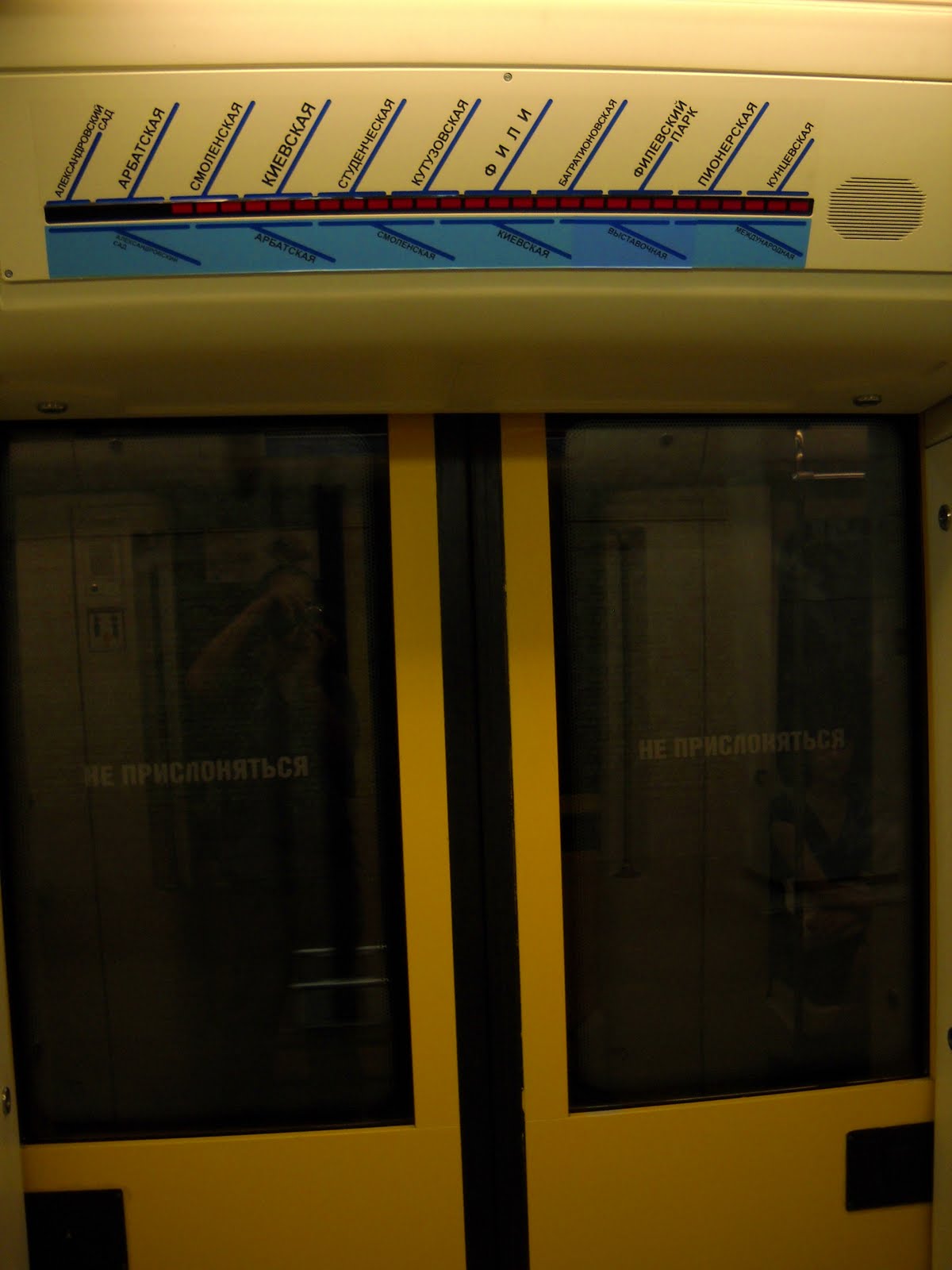 I stopped at the Lenina Library station. If I have turned left here, the Kremlin would be visible after a short distance.
 But I turned right, which took me on a roundabout route. But I was able to find this interesting-looking metro station on my way. It also become apparent during the walk that the Kremlin isn't that far from the hostel.
 Leave your lugguage at the gate of the Kremlin. There are storage facilities near the ticket counter. It's safe and free. The granny at the ticket counter insisted I gave her the exact change for the ticket. The security check went smoothly without much hassle.
 Once past the gate, you soon realised the Kremlin compound is a multi-purpose complex. Housed within its red walls, under the watch of its towers, are:
Onion-domed churches from when the Tzars ruled the vast nation. This is where they worshipped, asked for devine blessing before they sent their troops to far corners of their nation to quash some unrest, and, for some, serves as their final resting place.
 The tzars are no more, so the Kremlin now served as the seat of power of the federation. The federal buildings flying the Russian red-white-and-blue.
 Surprisingly, there are no barricade seperating the touristy part from the government buildings. A large square seperates these two parts, with a fleet of jet-black Mercs standing by in an island in that square.
 All that was needed were a few policemen standing guard at the edges of this square. Anytime some tourists tries to walk into out-of-bound area, they just point and with a wave of their palms signal the tourists to back off. If that don't work, all that was needed was a sharp blow into their whistle.
 There was even a modern structure housing a ministerial department.
 And how can we be sure this is a FORMER socialist republic if not for a sourvenir shop.
 Once out of the Kremlin, I followed the parameter walls until I found what looks like a memorial to fallen soldiers of the motherland.
 You can judge by the bright sky that it was a pretty hot day. I pity the army guys who were on sentry duty. Their offier actually have to march out to them once in a while, seemingly to ask if they are ok. One little boy went running towards the burning flame, before the officer hurriedly usher him off, with a understanding smile.
 As the crowd grows in size, I was sure the St. Basil cathedral is nearby. That's the name of that famous multi-color onion-domed church that is synonymous to Russia.
 Very soon, I am right at the gate leading to the famous Red Square, the cathedral framed by the arches of the gate.
 I took my time approaching the cathedral. Partly to savor the moment, partly because I fear being disappointed. That after crossing rivers and continents to come this far, the St. Basil cathedral would be another tourist trap.
 So, thanks to the Red Square, I got to take a leisurely stroll towards the St. Basil, as I observed the various posses the tourists adopted for their pictures.
 The building next to the St. Basil was under renovation. Probably because of its proximity with the St. Basil, the scaffolding looks like it was custom-made.
 The St. Basil isn't as tall as the one in my imagination. But it was not a disappointment, for it was a beautiful structure.
 The St. Basil does not have a large hall that where masses can be held. What it has are small rooms under its many towers, each with some holy relics, where one can just step back and look.
 Some rooms are dimly-lit by candles(or electric lamp shaped like candles), while other allows the sunlight in.
 I am sure photography is not allowed in the St. Basil, but the rule doesn't seems to be strictly enforced...if at all. Now that I am out of the St. Basil, and don't have to keep typing it, it's time to tell you that its official name is "The Cathedral of the Protecting Veil of the Mother of God upon the Moat".
 Leaving the St. Basil, the Kremlin and Lenin mausoleum is on my left. On my right is the famous GUM. It is a large shopping mall, like her Chinese counterpart, the Friendship Store. Back in the bad old communist days, it was famous for well-stocked shops where no ordinary citizens can actually patronize.
 These days, it is no different from any other such shopping mall in any other parts of the world. But at least most of the restaurant had English sign. I went for one that operate like a cafeteria, where you slide a tray along a long counter, and pick the food you want from the counter. The price are clearly displayed, and the food are grouped: you start along the counter with dessert, soup, main dishes, salad, pasta/rice, bread, drink and end with the cashiers. I did my tray-sliding and ended up with these:
 After dinner, I headed to the park by the Red Square to rest my tired ass. There was a couple, a black guy and a Russia woman, on one of the bench. No one was bothering them, which put those fear of getting mugged by skinheads at rest.
There's a monument in the park, showing the atlas of the northern hemisphere. Right above the equator (see the number '1'), is Singapore, which read like CHNTaIIVP in cryllic. And Kuala Lumpur right above read like KVaXa-XVMIIVP.
 I had wanted to wait for sunset and take a few pics of the St. Basil under moonlight, but past 8pm, there was no sign that the sun will set soon. So I head back to the hostel for a good sleep. At 10pm, the room was bright as day.
 Tomorrow will be a long day.


