Tuesday, 15 February 2011

June, 2010: Day 3 - The Trans-Siberia, Racing towards a Russian Sunset: Naushki to Nizhne Udinsk


The Russian bordertown is Dozorny, but it does not appear on the train time table. So I assumed that at around midnight we past it by and were parked on the track at Naushki station for the next 2 hours. We were locked in carriage while the Russians go through with immigration formalities and got off with our passport. The Chinese train advised against walking about in the carriage, poking our head out the windows or taking pictures. So, by the time I fired up my camera again, it was for this pic of Naushki station as the train resumed its travel towards Moscow, 5895km ahead.
By the time day breaks again, we were heading towards Ulan Ude, capital of the Buryat Republic of the Russian Federation. The Buryat people are of Mongolian descent. The girl from my carriage alighted here, I guess she is a Buryat, and that explains her Mongolian features.
Situated so far from Moscow, rust seems to set the tone to the cityscape. As we left the city behind, the log houses dotting the side of the track looked damp. The low gloomy sky didn't help. We crossed the Selenga River as we headed into the Lake Baikal district.
For much of the time between here and Irkutsk, the lake is right outside the windows.
Baikal is huge, you can't miss it on a map of Siberia. At times, you would think the track is hugging a sea coast.
The only other passenger left in the carriage was now suiting up, splashing on his favourite cologne.
It was obvious he was getting off at Irkutsk, as he rattle off facts about Baikal from his Trans-Siberia guidebook (incidentally the same as the one I have borrowed out of the library and carried on this trip. Although I suspect mine was an older edition).
With the Chinese restaurant car having been left behind at the Mongolia border, I was curious how the train crew are getting fed. Well, they were taking good care of themselves. It was now that I noticed that the washing-up room at the end of the carriage was well-stocked up with fresh produce. There was also a charcoal stove built into a compartment right next to the exit of the carriage.


By now, the Mongolian restaurant car had also been taken off, and a Russian one shunted on. Not ready to face the Russian menu and price tag, I broke out the ration again.
As the engine winds its way up the Primorsky Mountain, many opportunities for pic like this:
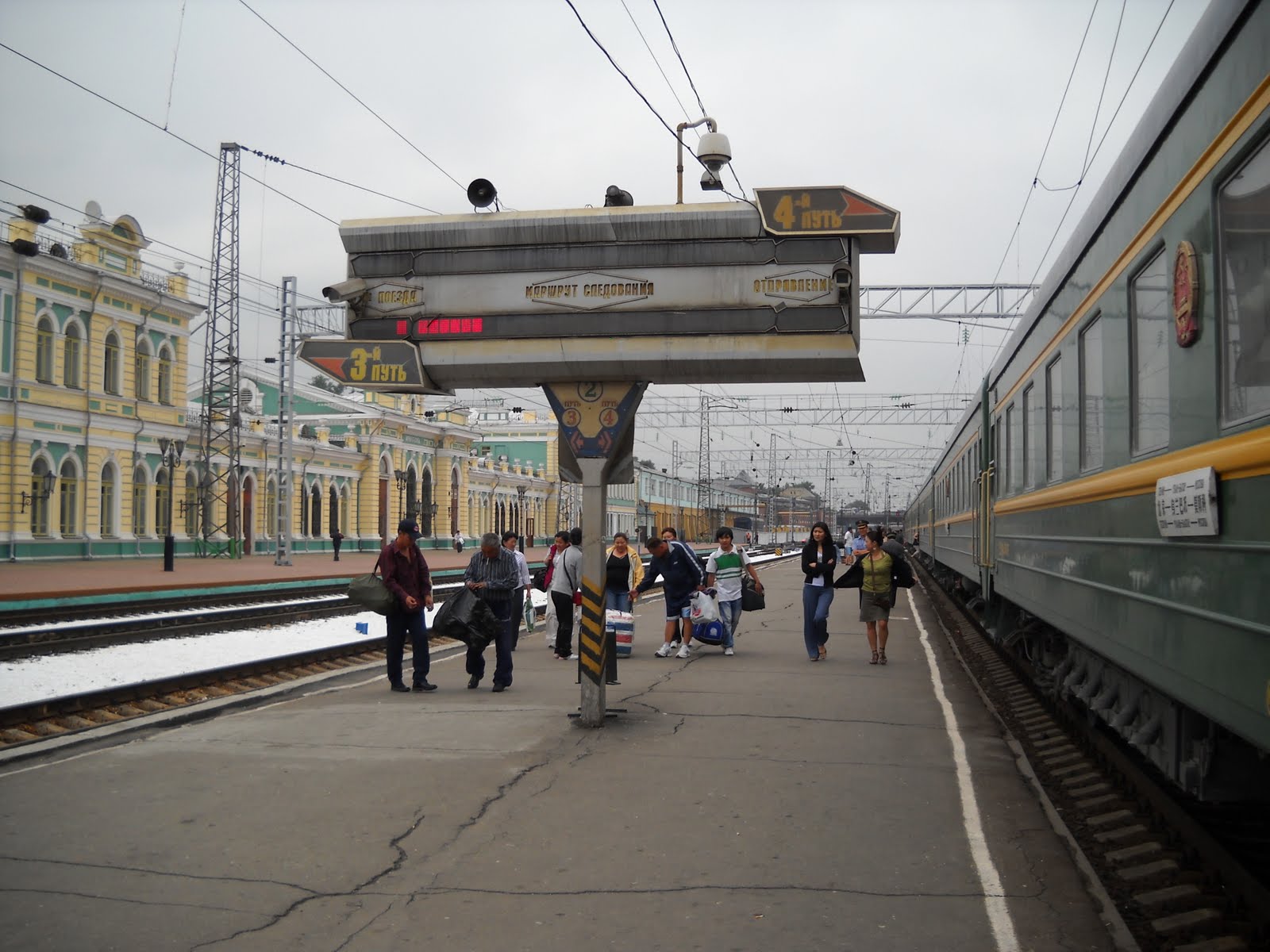
One hour after lunch, the train crossed the Angara River and slided into Irkutsk station.
The city of Irkutsk was once known as the "Paris of Siberia". She may have lost the title, but judging by the station alone, it was a much less gloomy place than Ulan Ude.
By now, my sense of time was getting a bit haywired. My biological clock is on Singapore time (GMT+8), the train is operating on Moscow time (GMT+4), Irkutsk is on GMT+9, while the light outside is a shade of these 3 timezone. I try to 'acclimatize' by simply going in and out of sleep. As a result, I totally missed Zima station. Zima is a place named after a season. In Russian, Zima means winter.
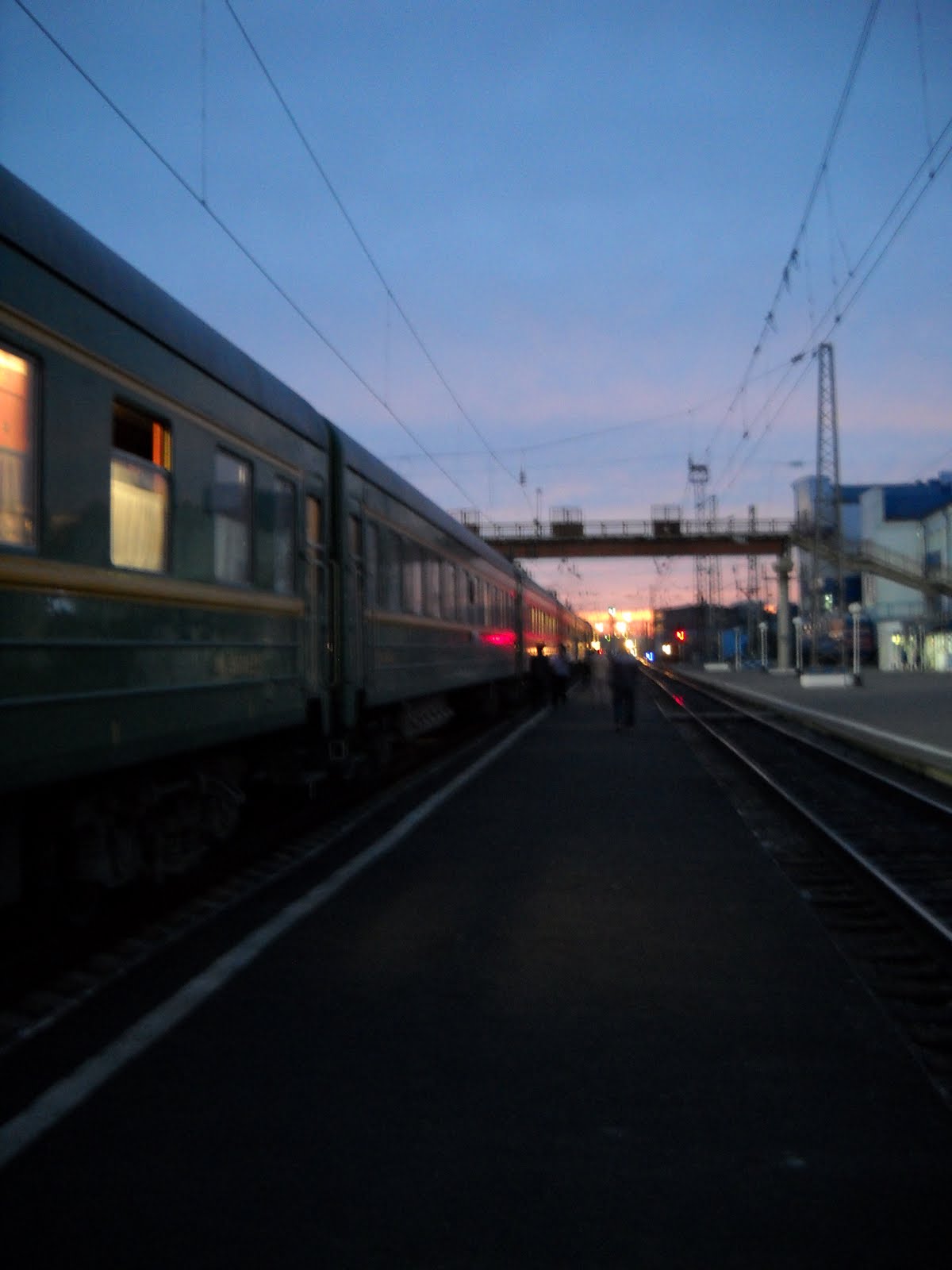
Sunset came after 10pm Singapore time, 6pm Moscow time, and 11pm local Irkutsk time.
The last station before we called it a day was Nizhne Udinsk. It was 16 degree C outside but I decided to get on the platform for a little stretch-leg.
June, 2010: Day 2 - The Trans-Mongolia: Ulaan Baatar to Sukhbaatar, Mongolia


The train stops at the UB station for about half an hour, and by the time it pulls out, it was obvious almost everyone else were on this train just to get to UB. Only three of us were left on my carriage: myself, a Russian girl (twenty plus, who looks more Mongolian to me; and an American college boy.) They were in another room, so I am left alone in the room:
1) I was happy that there will be less people to share the toilet with;
2) Sad that there will be no one to have a conversation with the next 2 days;
3) Happy that I would not have to talk once I ran out of topic in the 4th and 5th days;
4) and worried that the bunch of friendly roommates would be replaced by the infamous Russian drunks.


Four years ago, in the same month of June, I had taken the train from UB to the Mongolia border, SukhBaatar. Not sure about getting the Russian visa worked out in UB then, I have decided against crossing into Russia. But I had vowed to be back again and eventually cross the border on train.
I think I still have a vivid memory of the scenery along the way, being able to recall the prominent features in the landscape. Although, to be fair, the unchanging uniformity of the landscape did help a lot.
Deciding against paying another 12US$ at the restaurant car, it's time to break out the ration.


This being summer, the sunset came after 8pm.
It was after 10pm when the train arrived in SukhBaatar. It's another round of custom and immigration formality. I think this is where the Mongolian railway's carriages were taken off.
I would be another hour before the train pulled out of SukhBaatar, with uniformed guys (custom? immigration? army?) lined up on the platform and along the track saluting the departing K3.


The border seems to come with thickly forested (not rainforest-thick, but with pines.) I hope my flashlight that went off didn't spook any border patrol.
I am not sure if we crossed into Russia proper before midnight, but a quarter before 12, my cellphone was showing it had locked onto "MegaFon RUS". Whatever lies ahead, that vow from 4 years back had been acted upon.

June, 2010: Day 2 - The Trans-Mongolia: Inner Mongolia, China to Ulaan Baatar, Mongolia


And so, we rolled on.
With the custom formalities all worked out at Erlian station, entering Mongolia was a non-event, with only a huge dimly-lit signboard welcoming us. 7023km of railroad lies ahead. The distance marker by the sign of the track appears to by '8'. I guess we are just 8km down the Mongolian section of the railroad.
The next morning, the scenery outside changes again, the steppes of Inner Mongolia given way to the Gobi desert.
The first thing to do when I got up of bed was to check out the food situation. The Chinese restaurant car was replaced by a Mongolian one (either that, or someone really did pimped up my restaurant car) sometime last night. It was now all wood-panelling with a hunting theme. The food is no longer free now. Oh, how I missed the communist state of China. Mentally, I re-ration my food supply for the next 3 days.
A Mongolian sleeper carriage has also been shunted on the previous night.

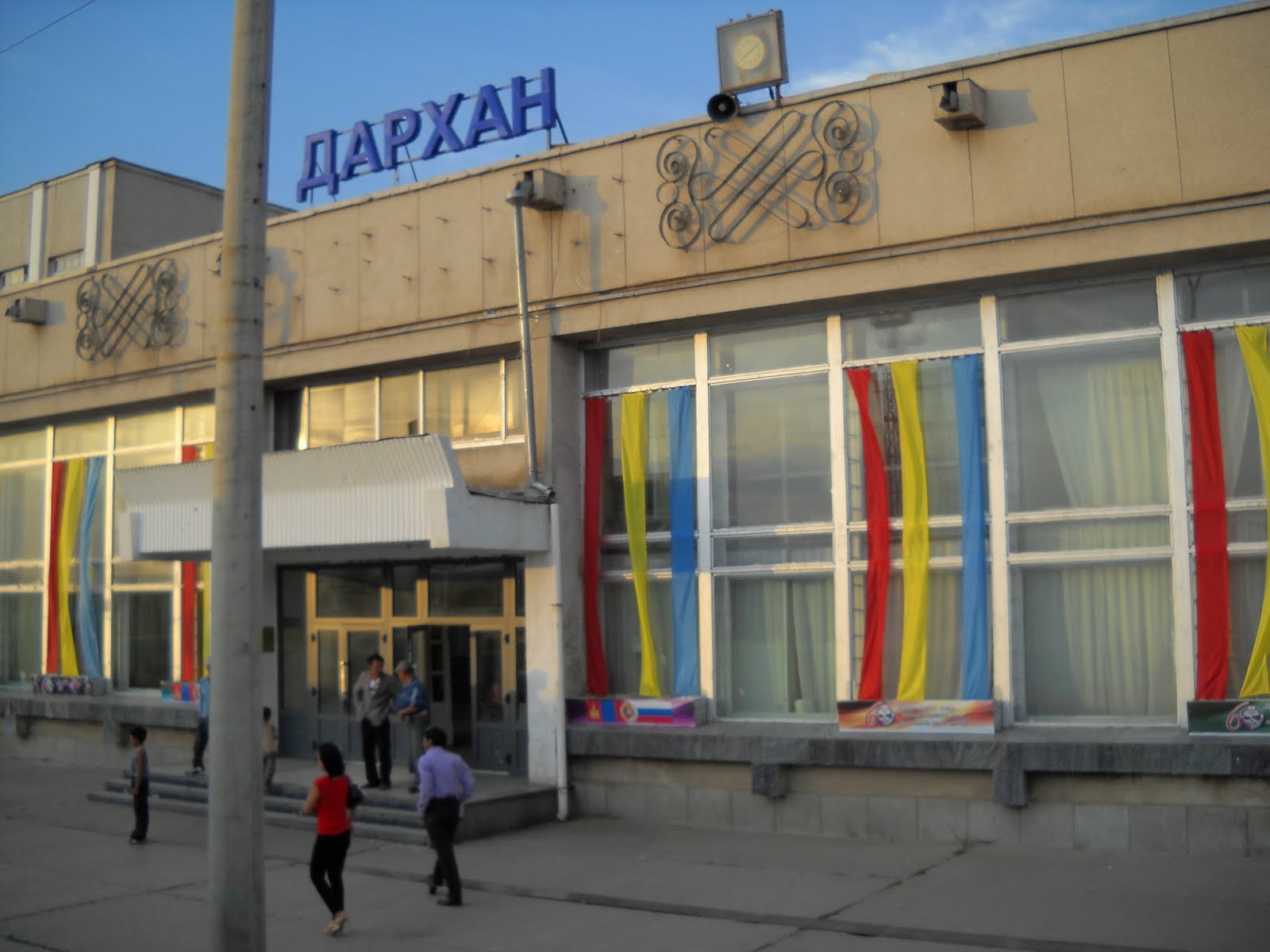
Choyr station, the train having travelled about 500km since crossing the border. Here, the stations name are in cryllic.
I went for lunch, the Mongolian waiter was recommending the steppe platter, something that would set me back about 30US$. I decided to go for mutton, which was more affordable at 12 US$.
The one thing I missed from when I was last in Mongolia was their mutton dishes. So it didn't take me long to polish off the plate.

After lunch, we seems to be leaving the Gobi behind as the steppe made its appearance.
Still, I guess this is harsh terrain. Witness death by the railway track.
Soon after lunch, the pasengers were stirring into action. From the number of them packing up, I supposed many would be alighting at Ulaan Baatar, capital city of Mongolia. They gathered on the corridor, exchanging notes on tourist info and phone numbers and fixing dates to meet in the city. The American in my room appeared to be travelling with his younger brother, who paid for a 1st class room with its attached shower. Which is why all the white guys seemed freshed and clean, probably having took turns in the shower. The American consulted the Mongolian roommate, and was assured that it would be safe for them to venture into the nightclubs (although, according to the Mongolian, a Chinese would easily run into Mongolians who are out to pick a fight).
MAY 2011 UPDATE--Trouble on the Steppe (...looks like the Mongolian's info was quite insider):
Now back to 2010...The excitment reached its cresendo as the track makes a wide arc as the K3 makes it approach into Ulann Baatar. By now almst everyone is on the corridor by the windows.
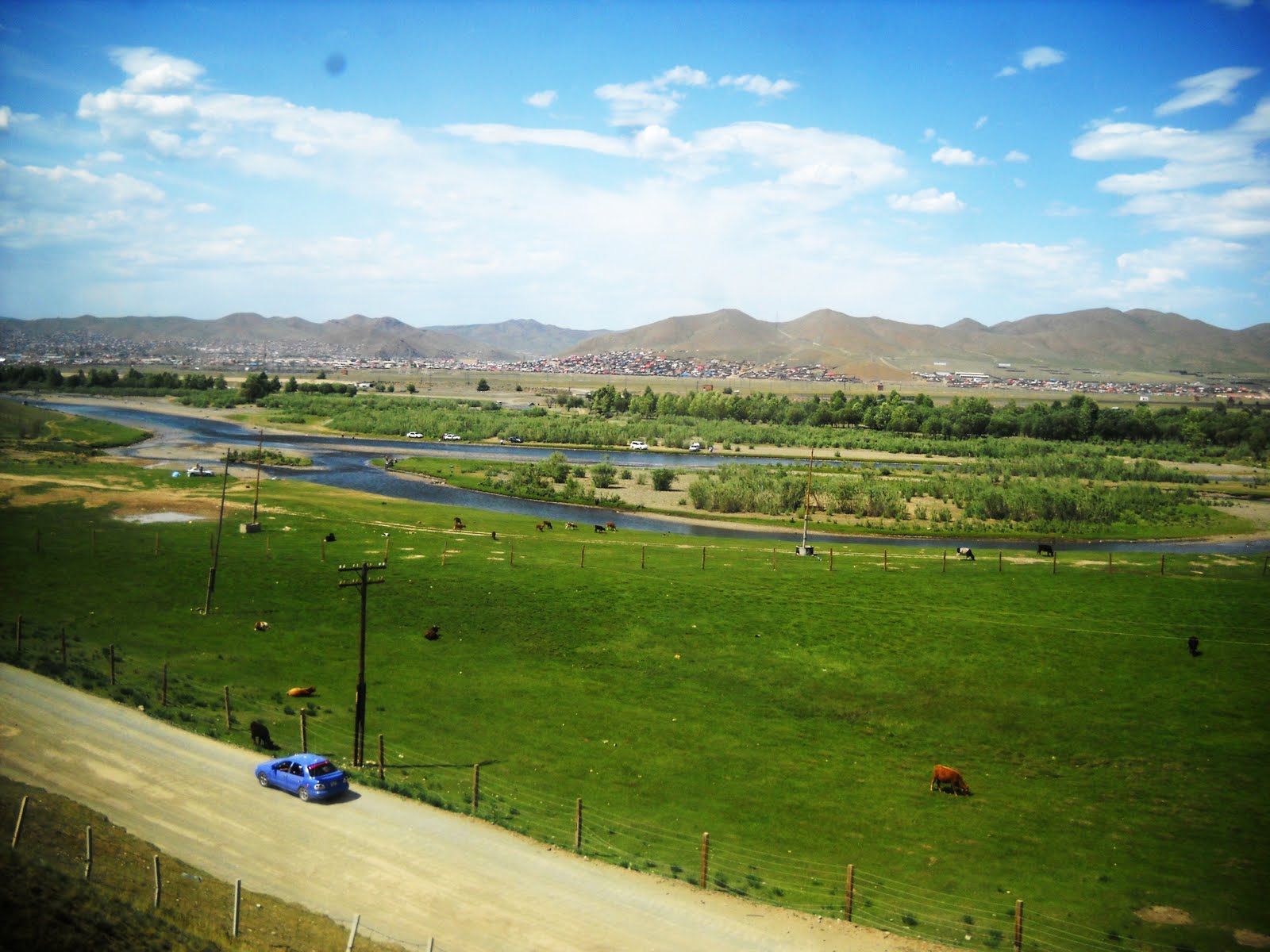
This is the capital city, but don't expect any tall buildings. Having been in UB some 4 years ago, the sight looks famiilar to me: the power stations' smoke towers, the graffiti on walls along the track, and the railway 'museum' (with retired engines) right before the train slides into UB station.

Thursday, 10 February 2011

June, 2010: This is IT, Day 1 - The Trans-Mongolia: Beijing to Inner Mongolia, China


By the time I got to the ticket inspection gate leading to the platform, there were already a line of passengers forming. Not surprisingly, most were caucasians. They seems not to be carrying too much food with them, so I assume food will be provided in the lunch car...at reasonable price. I stopped worrying that the amount of food I am dragging aboard won't last the distance. Another thing worrying me is that the limit on carry-on luggage will be strictly enforced. Luckily it wasn't. Waiting at the platform 7 is the K7, with the crew smartly decked out. These guys will be travelling the full 5 days of the trip with the passengers. And in those 5 days, there will be many opportunity to see them less smartly dressed.
At about 7:47am (off by just a few minutes), the K3 pulls out of the platform, lying ahead of her, and us, is 7865km of railroad. That's 4887 miles.

Once I got a look at my 3rd class carriage, it's obvious that most of the info I read are pretty outdated. It is far from shabby as described. Each carriage is divided into four beds (2 up 2 down) with toilet at one end and washing basins at the other. Doors at each rooms can be slide closed for privacy. 2nd class pasengers are basically paying for air-con, and 1st class for in-room shower.
I got a 'up' bed, sharing with a Yankee, a Brit, and a Mongolian travelling home to start college. I looks like the whole carriage was fully booked. I worried about the state of the toilet 2 or 3 days into the trip, what with all these people sharing it.

Before the excited passengers even settled down, the train was leaving Beijing city behind and heading west towards the countryside in ShanXi. It looks like the train was running along side a craggy mountain range.
Because I had been up the whole previous night, I was going in and out of sleep. but the scenery outside more or less stays the same. Once or twice, the mundane scenery was broken by sun-baked sparsely populated villages. The only highlight so far was a lone donkey tied to a pole baking in the sun. The conversation inside the train was more interesting. The mostly-caucasian crowd was getting introduced and was comparing notes on Mongolia. Turns out the American in our room had been teaching English in China (WuHan, I think) for about 2 years. He 'lamented' about how the more rural the place in China is, the more he was welocmed by the natives. And in urban Beijing, he was almost despised by the more 'sophisticated' natives. I can almost imagine him wandering around Beijing belting out "where is the love...".
When I woke at about 10am, I was pleasantly surprised by meal tickets on the little side-table in the room. So, this is the secret I was not let into: free food is provided on the train!! Hurray!!! No wonder everyone seems to be travelling light.
I was one of the first to arive at the restaurant car for lunch. It wasn't much: bowl of rice, cauliflower stirred fried with spam, and two meatballs drenched in sweet-and-sour sause. You pay for the drink of your choice.


With my stomach filled I went back to bed. By the time I woke at 3pm, we have left Datong, the city bordering ShanXi and Inner Mongolia, behind. So I never got to find out if the Great Wall can really be seen from the train.

It's obvious we are among the 'barbarian hoard' as the Chinese plain gave way to Mongolian steppes.
At about 6:35pm, we arrived at the inner-mongolia city (town?) of Zhurihe.
As the sun sets over the steppes, we pulled into Erlian, the last Chinese station of the trip.
Here, one Chinese guy, who wanted to go as far as his national railway will take him, bide us farewell.What follows was immigration formality, and the boogie changing, while we waited at the station.
You are free to leave the station to explore the town. Erlian is famous for dinosaur fossil finds. There is supposed to be a Dinosaur Park near the town square. There were 2 beams of light (the kind inspector Gordon used to summon Batman) shotting up into the otherwise dark nightsky. I supposed if I get to the source of the beams, there the town square would be. But not wanting to stray too far from the station, I just wander within a few blocks in front of the station.
There were quite a few hotels and brightly karaoke-restaurants near the station catering to Chinese attracted by their exotic bordertown. But just a few block off, the houses turn shabby, and the air reeked of uncollected rubbish.
The station has a well-stocked minimart, with fresh fruits and frozen food. The sale girls seem to be pushing the fruits, I guess they would be popular with travellers bearing gifts for the nomadic Mongolians. I could have easily stocked up here, but hoping that food will be free on the train all the way to Moscow, I just picked up a few stuff: tidbits, biscuits and ice cream to polish off at the waiting hall.


About 30 minutes before midnight, we were let back into the platform. We were joined by passengers boarding from Erlian. By now, the boogie had been changed, and so had the engine. The Mongolian Railway engine takes over from the Chinese one.